|
Thai Heritage
Massage and herbal healing are presumably as old as the human race. After hunters returned to their caves with aching limbs, their mates probably tried to rub away the stiffness. Meanwhile,while foraging the forests, they would find wild plants and, after experimentation, discover that some had amazing medicinal properties.
Over time, this knowledge was refined and passed down, first orally from generation to generation. Later, samut khoi, parchment texts, were produced. As trade and relations began to develop between villages, then city-states and finally kingdoms, this know-ledge was shared and adopted.
Earth, wind, fire, and water. No, not a band’s name, but the four elements that must be balanced for a person to be healthy. This is the basis for Thai traditional healing.
While this theory has it roots in Indian Ayurvedic principles first introduced in Thailand during the second or third centuries BC, when Buddhist monks arrived to teach their new religion, Thais must have already been concocting herbal remedies, as it has always been the nature of man to discover better solutions for survival. Through trial and error and accident,the earliest people learned about the wild plants that grew around them, and when they settled and became farmers, they would plant gardens for their herbs and spices.
In Thailand, as in other countries, the people would pass on their knowledge orally from generation to generation. In addition to the Indians, the Chinese and Egyptians were writing their herbal treatments down in such treatises as the Sern Nong Pen Lao and Eber Papyrus respectively, both dating back thousands of years.
The Ramkhamhaeng Stone Inscription is the earliest evidence of Thai ethno healing, as it describes the royal plant garden. Even before this, though, during the Khmer Empire that ruled the Northeast, it is recorded that King Jayavarman VII ordered the establishment of 102 arokaya sala, or traditional healing hospitals. Much later, in the 16th century, when King Narai ruled Siam from his seat of power in Ayutthaya, he had both hospitals and the herbal dispensaries opened. After the fall of Ayutthaya and the founding of Bangkok, King Rama III began to promote ethno healing, establishing a school at Wat Pho. However, interest waned as the Government and people turned their attention to, and put their trust in, Western medicine.
But, in 1938, a project was initiated in the northern province of Chiang Mai to cultivate the herb cinchona to produce quinine, but it was not economically viable. With World War II and a lack of sufficient quantities of drugs, the Government again turned its attention to herbal remedies. They even engaged a German expert, to establish an experimental medicinal garden in the eastern province of Chanthaburi. After a short time, the doctor produced a report in English and Thai listing as many as 400 indigenous plants, their characteristics, and medicinal values.
After the World Health Organization began to promote national traditional heritage in 1977, the Thai government added ethno medicine to its five-year national economic and social development plans. The Foundation for the Promotion of Thai Traditional Medicine was established and, over the years, the interest in and importance of herbal healing has continued to grow.
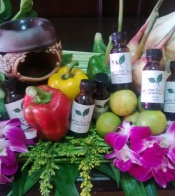
Snuff, inhalants, gargling solutions, teas, infusions, tonics, alcoholic macerates, oral dosages, pills, capsules, tablets, poultices, ointments, essential oils, and suppositories - herbal remedies come in a vast variety of forms. Those taken orally are often classified by their taste - sweet, bitter, astringent, acrid, nutty, salty, and sour, which then correlate with their healing attributes. For example, an herb with a cooling flavor will be prescribed for someone suffering from an ailment caused by a fire element imbalance, or an acrid taste will restore the wind element to a balanced level.
Traditional herbalists, like Thai masseurs and masseuses, have a guardian spirit they pay homage to. In addition to Shivaga Komarpaj, the Ayurvedic practitioner who treated the Lord Buddha and is considered the father of Thai traditional medicine, Thai homeopaths also pay homage to Phra Mae Thorani, “Mother Earth,” and will chant a small prayer when they collect the plants. While certain districts and provinces are known for having superior species because of their climate and soil, there are also specific times that are best for collection; for example, the evening flower jasmine should be picked at night or just before sunrise. Furthermore, it is always best to collect plants during the full moon, when the elements are at their maximum power.
There are three basic ways to classify medicinal herbs: those taken internally, applied externally, and inhaled. Many, though, fall under two or even all three of these classifications. Herbal drugs can have from two to as many as 40 different ingredients, which are also classified by species and medicinal attributes. Then, there is Thai cuisine, which, while famous for its flavors, is also known for its healing properties. As the different dishes can kindle and arouse as well as soothe the senses, the different spices and ingredients are again included to achieve a harmony of the body’s elements, thus serving as a preventative or curative of different symptoms and ailments.
In addition to treating various symptoms and ailments, many Thai medicinal herbs are used to spice up the various dishes. Thais love to combine very different flavors, hot, sour, sweet and bitter, which create culinary delights that are also curatives, as they balance the four elements: wind, water, earth, and fire.
|
|
Featured Item |